
Designing Smart Solutions:
P.A.W.
This project highlights my approach to product ideation, user-centered design, and strategy development. From identifying a real-world sustainability challenge to designing a seamless, household-friendly solution, it reflects my passion for creating innovative products that merge technology with everyday impact.
Overview
The Class
COS448: Innovating Across Technology, Business, and Marketplaces focuses on the intersection of technology, business, and design. The course emphasizes leveraging design thinking and prototyping to develop innovative solutions to real-world problems, balancing technological feasibility, business viability, and user desirability.
As part of the class, we completed a semester-long project where we conceptualized, designed, and refined a product idea from initial research to a Minimum Viable Product (MVP) and a go-to-market strategy. Each step involved deep dives into market analysis, prototyping, and collaborative problem-solving.


The Product: P.A.W. – Precision Automated Waste-Sorter
P.A.W. (Precision Automated Waste-Sorter) is an AI-powered, in-home waste sorting bin designed to simplify recycling and promote sustainable living. Inspired by Bin-e, a Polish company specializing in smart waste bins for public spaces, P.A.W. adapts and optimizes this concept for domestic use, catering specifically to the needs of households.
With a compact design that fits seamlessly into kitchens, utility rooms, or other small spaces, P.A.W. uses image recognition technology to automatically sort waste into trash, recyclables, and compost. Each item is identified and categorized as it’s disposed of, ensuring proper sorting with minimal effort. The bin features three separate compartments with removable liners, making it easy to maintain and clean.
P.A.W. also integrates with a free mobile app, allowing users to monitor compartment fullness and gain insights into their waste habits. By encouraging environmentally responsible practices at home, P.A.W. helps individuals and families make small changes that collectively contribute to a positive environmental impact. While primarily targeting households, P.A.W. also has potential applications for small businesses, such as coffee shops, that can inspire consumers to adopt similar practices at home.
Market Assessment
P.A.W. would be developed in the United States, with teams based in Palo Alto, California, and manufacturing and testing conducted in Fremont. This location would allow us to tap into the tech-driven innovation of the Bay Area, positioning P.A.W. to meet the needs of environmentally conscious consumers.
.
Setting the Scene
Top-Down Market Assessment
To understand P.A.W.'s potential, we would conduct a top-down market analysis targeting households and small businesses in developed countries. These regions generally have the disposable income and infrastructure necessary for a product like P.A.W., as well as higher environmental awareness.
Key Insights:
-
Developed countries lead sustainability efforts, with established recycling and waste disposal systems.
-
Basic needs being met allows households to focus on broader issues, such as climate change.
From our research on 37 OECD-developed countries, we compiled the following data on households and small-to-medium enterprises (SMEs):
.
Country
Household Size
SME Size
EU-27
220 million
25.1 million
United States
128 million
31.7 million
Japan
53 million
5.5 million
UK
27.8 million
6 million
South Korea
21million
3.5 million
Canada
14.8 million
1.2 million
Australia
9 million
2.3 million
TOTAL
474 million
75.8 million
This gives us a total of approximately 550 million households and SMEs in developed countries.
Market Potential
Total Addressable Market (TAM):
-
All households and SMEs in developed countries: 550 million
-
Potential revenue (at $400/unit): $220 billion
Service Addressable Market (SAM):
-
Focus on U.S. households and SMEs: 159.7 million (29% of TAM)
-
Potential revenue: $64 billion
Service Obtainable Market (SOM): To estimate the portion of the SAM that P.A.W. could realistically capture, we analyzed green awareness and recycling habits in the U.S., referencing data from a Qualtrics, SAP & WEF survey. Key findings revealed:
-
94% of Americans support recycling, and 74% believe it should be a top priority.
-
However, only 35% actively recycle, citing lack of convenience as the primary barrier.
-
36% of businesses prioritize waste-free processes, while 39% emphasize sustainability as a critical focus.
Based on these insights, approximately 37% of U.S. households and small businesses in our SAM would see value in P.A.W. and be willing to purchase it. This equates to 59 million potential customers and an estimated revenue of $23.6 billion.
Minimal Viable Product
Core Features
Smart Sorting
Automatically sorts waste into trash, recycling, and compost, eliminating guesswork and maximizing landfill diversion.
Eco-Impact Reporting
Tracks user waste habits, provides feedback, and offers personalized reports on carbon footprint reduction and resources conserved.
Intuitive Mobile App
Notifies users when compartments are full, schedules reminders, and integrates seamlessly with local waste management calendars.
Supports All Waste Types
Handles all recycling, compost, and household waste categories, ensuring precise sorting for every disposal need.
Data Privacy
All user data related to waste disposal habits are encrypted and securely stored, with the option for users to opt-out.
Gamified Rewards
Encourages consistent use by offering redeemable points for discounts, donations, or sustainable purchases.
Seamless Design
Compact, quiet, and efficient, P.A.W. integrates easily into any home or business space.
Waste Forecasting
Machine learning analyzes disposal trends, helping users plan waste reduction strategies and shopping habits proactively.
High Efficiency Sorting
Achieves 96% sorting accuracy, minimizing cross-contamination and boosting recycling efficiency.
Competitor Analysis

Timeline
-
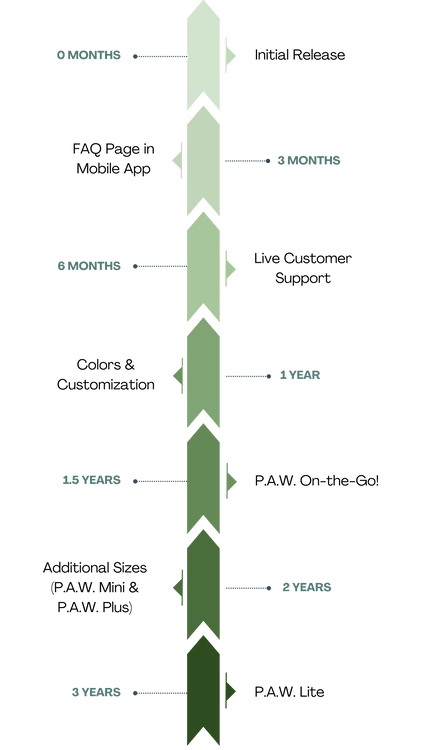
0 Months: Initial Release of P.A.W.
-
3 Months: FAQ Page Integration
Launch a comprehensive FAQ page in the mobile app, based on customer feedback, to address common issues, troubleshooting, and functionality questions.
-
6 Months: Live Customer Support
Add in-app support for complex issues and hire trained support agents ("P.A.W. Patrol"). Use customer surveys to improve chat experiences.
-
1 Year: Colors & Customization
Offer new color options and custom branding services for businesses. Enable users to submit personalized orders via a dedicated webpage.


-
1.5 Years: P.A.W. On-the-Go
Integrate P.A.W.’s sorting technology into the mobile app, allowing users to identify waste types via their phone’s camera. Implement adaptive machine learning to refine sorting accuracy based on user feedback.


-
2 years: Additional Sizes (P.A.W. Mini and P.A.W. Plus)
Launch P.A.W. Mini for budget-conscious users and P.A.W. Plus for businesses, expanding price options while maintaining core functionality

-
3 years: P.A.W. Lite
A compact, retrofittable device that uses P.A.W.’s core object recognition technology to guide users in waste sorting. Designed for affordability, it enables households, businesses, and more to upgrade existing bins without major changes.


Go-to-Market Strategy

Vision for Growth
P.A.W. strategically focuses on high-impact customer segments to drive early adoption and long-term growth:
-
Eco-Conscious Families: Tech-savvy households prioritizing sustainability and convenience, eager to adopt smart home innovations.
-
Sustainability-Driven Businesses: Small enterprises, like cafes and eco-stores, looking to enhance their green brand identity and streamline waste management.
-
Educational Institutions: Schools and universities committed to sustainability education, providing opportunities for visibility and widespread adoption.
Phase 1: Pilot Markets
Launch in Palo Alto and San Francisco—epicenters of green innovation and technology. These regions’ early adopters serve as influential brand ambassadors, driving word-of-mouth and organic growth.
Phase 2: National Rollout
Expand to eco-conscious metropolitan areas like Los Angeles, Austin, and Boston, leveraging partnerships with local environmental organizations and community influencers.
Phase 3: Broader Reach
Extend to diverse U.S. markets, tailoring marketing to regional sustainability needs and recycling challenges.
P.A.W. combines advanced AI with user-centric design to revolutionize waste management:
-
Precision Sorting: 96% accuracy in categorizing waste into trash, recyclables, and compost.
-
Actionable Insights: Data-driven feedback educates users, while gamified rewards inspire sustained eco-friendly behavior.
-
Seamless Integration: Compact, sleek, and easy to use, P.A.W. fits into any home or business, enhancing convenience and impact.
P.A.W. isn’t just a product; it’s a lifestyle upgrade, empowering users to actively contribute to a more sustainable future.
Maximizing accessibility and visibility through diverse channels:
-
Direct Sales: P.A.W.’s website, enhanced by a virtual assistant for seamless user support.
-
E-Commerce: Platforms like Amazon and eBay to tap into eco-conscious online shoppers.
-
Retail Partnerships: Collaborate with green retailers and smart home product stores to attract high-value customers.
-
Community Pilots: Partner with NGOs, local governments, and schools to introduce P.A.W. in public and educational spaces.
-
Events & Expos: Showcase P.A.W. at green expos, trade shows, and pop-up events, connecting directly with sustainability enthusiasts.
P.A.W.’s dynamic marketing campaign is designed to inform, engage, and inspire:
-
Live Demonstrations: Trade shows and community events to showcase P.A.W.’s capabilities.
-
Digital Campaigns: Leverage social media platforms (Instagram, TikTok, LinkedIn) with influencer partnerships and compelling content.
-
Localized Campaigns: Tailor promotions to address regional sustainability challenges, fostering community engagement.
-
Referral Programs: Incentivize existing users to share P.A.W., driving organic growth and trust.
-
Collaborations: Align with environmental organizations to amplify credibility and reach eco-conscious audiences.
A multi-faceted revenue model ensures market penetration and sustained growth:
-
Direct and Indirect Sales: Via e-commerce, retail, and direct website purchases.
Flexible Financing: Offer installment plans to increase accessibility without compromising value. -
Special Offers: Discounts for early adopters, educational institutions, and bulk business purchases.
-
In-App Advertising: Feature eco-friendly brands within the app for additional revenue.
P.A.W.’s strategy capitalizes on the intersection of sustainability, technology, and convenience, creating a robust foundation for national expansion. By addressing critical waste management needs and empowering users, P.A.W. aims to lead the charge in smart, sustainable living.
Target Audience
Launch & Expansion Phase
Value Proposition
Distribution Channels
Marketing Strategies
Monetization Plan
Key Learnings & Skills Gained
Through the conceptual development of P.A.W. in COS448, I gained valuable insights and developed key skills that are highly relevant to designing and planning impactful solutions:
Key Learnings
-
Systematic Problem-Solving: Gained a structured approach to tackling complex challenges, emphasizing research, user understanding, and creative solutions.
-
Importance of Thorough Planning: Recognized how in-depth conceptualization, even without implementation, ensures that a product idea is both viable and aligned with market needs.
-
Strategic Thinking for Market Entry: Learned the importance of phased rollouts, starting with early adopters and leveraging local ecosystems for broader adoption.
-
Balancing Vision with Feasibility: Developed an appreciation for balancing ambitious, innovative ideas with realistic market, technical, and budgetary constraints.
-
Integrating Sustainability: Understood how sustainability can be a core driver of innovation, market appeal, and long-term impact.
Skills Gained

Design Thinking
Applied a structured, iterative approach to conceptualizing solutions that address complex, real-world challenges.
Strategic Product Vision
Cultivated the ability to define a product vision that balances user needs, market opportunities, and business objectives.

Market Analysis
Conducted top-down assessments, customer segmentation, and competitive analysis to inform strategic decisions.

Collaborative Ideation
Worked effectively with a team to brainstorm, allocate responsibilities, and refine ideas collaboratively.

Business Planning
Crafted detailed strategies for product development, distribution, and monetization, simulating real-world scenarios.

Effective Storytelling
Developed the ability to articulate complex, high-level concepts into clear, compelling narratives for diverse audiences.